Visualizzazione post con etichetta Biblioteche. Mostra tutti i post

12.7.26

What’s So Great About the Great Books?

What’s So Great About the Great Books?: Why You Should Read Classic Literature (Even Though It Might Destroy You) by Naomi Kanakia; Princeton University Press

It would be tempting to put Naomi Kanakia’s new book on the crowded shelf of recent works that have sought to defend the importance of a liberal arts education, particularly the humanities. Roosevelt Montás’s Rescuing Socrates (2021) is the most logical precursor to set it beside. But in championing Great Books, Kanakia is not staking out ground in campus curriculum debates. Instead, she addresses the lay reader, Virginia Woolf’s “common reader,” the nonacademic reader who, like Kanakia, may have spent formative years reading science fiction or fantasy more than literary fiction or philosophy. A convert to the Great Books in her 20s, Kanakia wants the Gone Girl reader (her example) to at least consider moving on to Proust and Middlemarch. Todd Shy, The American Scholar

29.5.22

Not Unpacking My Library

I have moved a lot in my life, too much, and in the chaos that every move entails, in the churning and trashing of possessions, in the reckoning with everything unfinished and forgotten that inevitably rises to the surface, it is the unpacking of books that always served as a kind of a ritual act, an alignment of physical and mental: I’d look at them and feel that I finally landed, that I’m back in the familiar. [...]

This time around, though, our books are not making me feel content or at home, and that’s why there are still 15 or so hefty boxes stacked atop of each other. [...]

Seriously: Is there another way for me to construct an outward-facing identity? As Walter Benjamin admitted, pacing around his own still-in-crates library, “what else is this collection but a disorder to which habit accommodated itself to such an extent that it can appear as order?” Jake Marmer, Tablet

la complicata relazione con i libri e con la lettura. Ma anche la complicata relazione con la scrittura:

Still, the act of writing poses a predicament for anyone who recognizes the temptations of pride and self-aggrandizement. We simultaneously desire to attract recognition and seek to avoid it. We want to engage an audience, yet we see that approbation flatters our egos and that criticism is painful. Although wiser people tell us not to read comments, with today's technology, readers' responses are exceedingly difficult to evade. And try as we might to ignore them, the words of critics can still wound us.

How, then, should we think about displaying ourselves — or at least our thoughts and words — in public? And where does the allure of public writing leave the activity of scholarly writing? Elizabeth Corey, National Affairs


8.5.22

Old Bookstores

Marius Kociejowski opens his enthralling memoir, “A Factotum in the Book Trade,” (Biblioasis) by observing that bookstores have begun to follow record stores into nonexistence. “With every shop that closes so, too, goes still more of the serendipity that feeds the human spirit.” While there may be “infinitely more choice” in buying from online dealers, “to be spoiled for choice extinguishes desire.” As he says, “I want dirt; I want chaos; I want, above all, mystery. I want to be able to step into a place and have the sense that there I’ll find a book, as yet unknown to me, which to some degree will change my life.” Michael Dirda, WP

21.11.21

Books Do Furnish a Civilization

IN THEIR NEW BOOK, The Library: A Fragile History, a splendid study of the institution of the library from its origins until today, Andrew Pettegree and Arthur der Weduwen recount the initiation, the innovations, and the dissolution of library after library, personal as well as public, scholarly as well as lending, over the centuries. The word “fragile” in their subtitle touches on the unsettled conditions of libraries throughout history. For books have everywhere and at all times been lost, stolen, vandalized, spoiled by neglect, while entire libraries have been abandoned, systematically despoiled, set afire, even deliberately bombed. Joseph Epstein, Commentary

interessanti riflessioni sulle biblioteche, e anche sui classici, con qualche sorprendente scoperta, e altre considerazioni più à la page:

Historically, in America, the true strength of the Classics and of a Classical education has not been among the elite but among the rising middle class. Naomi Kanakia, LA Review of Books


20.6.21

Biblioteche

From the British Library to the Brontë Parsonage Museum, a consortium of libraries and museums have come together in an “unprecedented” effort to raise £15m and save an “astonishingly important” set of literary manuscripts for the nation.

The plans were formed after the announcement last month that the “lost” Honresfield library was to be put up for auction at Sotheby’s this summer. Almost entirely inaccessible since 1939, the library was put together by Victorian industrialists William and Alfred Law at the turn of the 20th century, and is a literary treasure trove that had experts dancing with excitement – and warning that action needed to be taken to prevent it being sold piecemeal to private collectors. Alison Flood, The Guardian

Il controverso caso di Amy Chua, la Tiger Mother, docente di legge a Yale e ora accusata di party scatenati durante il Covid. "The question has arisen, in online comments sections and on Twitter, why anyone is even talking about Amy Chua. Who cares about a parenting memoirist’s removal from a law-school teaching roster? The answer is, in part, because this story manages to touch on seemingly every single cultural flashpoint of the past few years. Chua’s critics see a story about #MeToo—because of her husband, but also because Chua supported the nomination of Brett Kavanaugh to the Supreme Court, even after he was accused of sexual assault. Meanwhile, Chua’s defenders see a morality tale about liberal cancel culture. “What they’ve done to you is SOP”—standard operating procedure—“for conservative allies but chills me to the bone nonetheless,” a supporter tweeted at her, earlier this month. Megyn Kelly weighed in, tweeting, “Make no mistake: this is retribution for her support of Brett Kavanaugh, & it is disgusting.” Chua’s allies have also suggested that anti-Asian bias is involved. “The woke academy reserves a special vitriol for minority faculty who don’t toe the line politically,” Niall Ferguson, a historian, tweeted". Lizzie Widdicombe, The New Yorker

4.10.20

the world's strangest books


Edward Brooke-Hitching grew up in a rare book shop, with a rare book dealer for a father. As the author of histories of maps The Phantom Atlas, The Golden Atlas and The Sky Atlas, he has always been “really fascinated by books that are down the back alleys of history”. Ten years ago, he embarked on a project to come up with the “ultimate library”. No first editions of Jane Austen here, though: Brooke-Hitching’s The Madman’s Library collects the most eccentric and extraordinary books from around the world... Alison Flood, The Guardian

26.9.18

Raccolta di testi ebraici rari arriva alla biblioteca della Brown


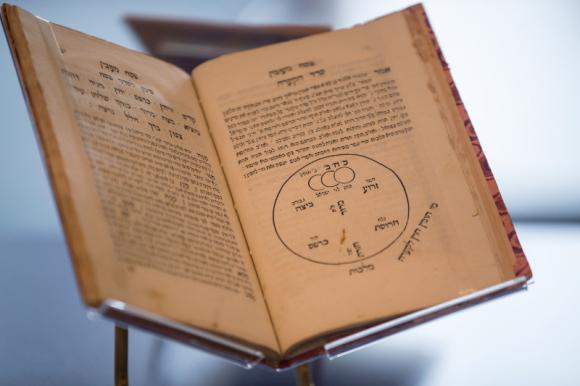
The Brown University Library is now home to a collection of rare illustrated texts that depict how Jewish communities have celebrated the Passover Seder across the globe, spanning more than 400 years and in a wide range of languages. 

21.5.14

La New York Public Library rinuncia a ridurre gli stack

Last week, the Times reported that the New York Public Library, in a surprising about-face, has given up on its plan to tear seven stories of bookshelves out of its white-marble flagship building, on Forty-second Street and Fifth Avenue. The bookshelves, usually referred to as “the stacks,” literally hold up the palatial reading room on the library’s third floor, and, in 2008, when the plan to remove them was first announced, they contained the heart of the library’s research collection. Under that plan, administrators hoped to move a portion of the books in the stacks to an existing facility underneath Bryant Park, which is next door to the library, and to ship the rest to an off-site storage facility in New Jersey. newyorker.

5.6.12

In difesa delle biblioteche

Un bell'articolo di Zadie Smith (che scrive molto bene) in difesa delle biblioteche. "What kind of a problem is a library? It’s clear that for many people it is not a problem at all, only a kind of obsolescence. At the extreme pole of this view is the technocrat’s total faith: with every book in the world online, what need could there be for the physical reality? This kind of argument thinks of the library as a function rather than a plurality of individual spaces. But each library is a different kind of problem and “the Internet” is no more a solution for all of them than it is their universal death knell". nybooks.

22.6.11

NYPL

Ho letto un articolo molto interessante sulle innovazioni tecnologiche - nell'Internet information ecosystem come viene chiamato - create e adottate dalla New York Public Library che non solo la stanno facendo crescere (in un periodo in cui le biblioteche, come i giornali, sembrano essere diventate obsolete), ma sono esemplari di come istituzioni culturali pubbliche possano essere da guida nel trovare soluzioni innovative a servire meglio gli utenti. Se solo potesse succedere anche da noi! (dovremmo far leggere questo articolo a Pisapia) "With all this change - not to mention a possible $40 million budget cut looming - it would be no surprise if the library was floundering like the music industry, newspapers, or travel agents. (Hey, man, we all get disintermediated sooner or later.) But that's the wild thing. The library isn't floundering. Rather, it's flourishing, putting out some of the most innovative online projects in the country. On the stuff you can measure - library visitors, website visitors, digital gallery images viewed - the numbers are up across the board compared with five years ago. On the stuff you can't, like conceptual leadership, the NYPL is killing it.
The library clearly has reevaluated its role within the Internet information ecosystem and found a set of new identities. Let's start from here: One, the New York Public Library is a social network with three million active users and two, the New York Public Library is a media outfit". theatlantic.